


Research Mission Cluster of Excellence IntCDC
The vision of the Cluster of Excellence Integrative Computational Design and Construction for Transformative Architecture (IntCDC) is to harness the full potential of digital technologies in order to rethink design, fabrication and construction based on integration and interdisciplinarity, with the goal of enabling game-changing innovation in the building sector as it can only occur through highly integrative fundamental research in an interdisciplinary, large-scale research undertaking.
Project description RP 16
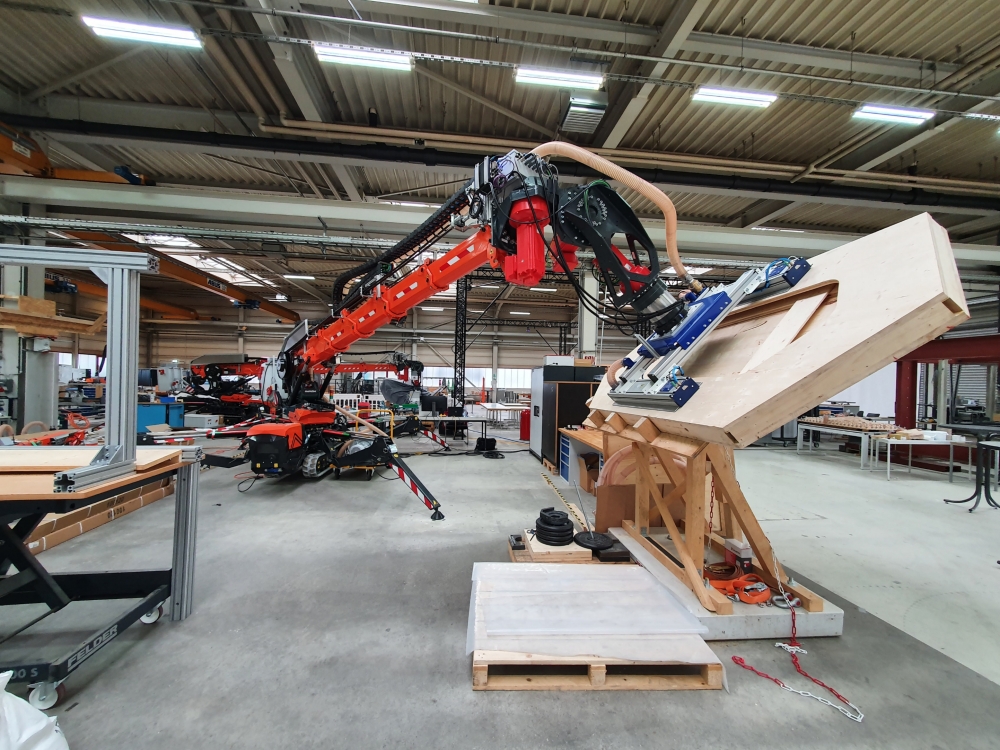
The aim of project RP 16 within the Cluster of Excellence IntCDC is to develop autonomous and cooperative large-scale manipulators for complex construction processes. Building on the results of the previous project phases, the robotic spider cranes are augmented to enable autonomous locomotion and outrigger deployment. To this end, methods for environmental perception, localization, motion planning, and control are being developed. Particular emphasis is placed on ensuring the stability of the cranes on uneven terrain and under varying load conditions.
For assembly and disassembly tasks, model-based and learning-based methods using force and visual feedback are being investigated. The robots are intended to operate with increasing autonomy, while human operators can continue to intervene, make decisions, or supervise task execution depending on the task and level of autonomy. To this end, adaptive human–robot interfaces are being developed in collaboration with the Institute of Human Factors and Technology Management (IAT). In addition to conventional operator controls, interaction modalities such as gestures, voice commands, haptic feedback, and AR/VR-based visualizations are being investigated.
Another research focus is learning from human demonstrations and interventions. Human strategies are used to teach the robots new skills and progressively increase their autonomy. Model knowledge as well as explicit task and safety constraints are combined with learning-based methods to enable robust transfer to different construction-site conditions.
In addition, the collaboration of multiple large-scale manipulators is being investigated. Cooperative control and planning methods are being developed to enable multiple spider cranes, or combinations of spider cranes and tower cranes, to jointly manipulate construction components. Particular consideration is given to load sharing, the structural compliance of the manipulators, and the tipping stability of the machines involved.
Serial facade renovation of existing buildings serves as the overarching application scenario. Due to large construction components, stringent positioning accuracy requirements, work at height, and discrepancies between digital building models and actual as-built conditions, this scenario poses particular challenges for autonomous construction robotics. The developed methods are first validated in simulation and subsequently on the real hydraulic large-scale manipulators.
RP 16-3 Description IntCDC Website Including List of Publications
Contact

Philipp Wasserloos
M. Sc.Scientific Employee